Travel
Pet relocation from Singapore, and where your dog stays in between
Moving a dog out of Singapore is a paperwork exercise with a hard deadline attached. The part nobody plans for is the fortnight in the middle, when the flat is empty and the flight is not for another ten days.
- Reviewed July 2026
- Sources cited inline
- 11 sections
At a glance
TL;DR. Exporting a dog from Singapore runs on three AVS steps: check the destination country's import requirements, apply for an export licence within 90 days of export, and obtain a veterinary health certificate. The owner is the applicant, even with an agent involved. The destination country's rules, not Singapore's, set your timeline. And the fortnight between handing back the flat and boarding the plane is a boarding problem that most relocation guides never mention.
What does pet relocation from Singapore involve?
Pet relocation from Singapore is the regulated export of a dog or cat overseas, and the Animal & Veterinary Service lays it out in three steps. You check the destination country's import requirements. You apply for an AVS export licence within 90 days of the export date. You obtain a veterinary health certificate. The AVS guidance on exporting dogs and cats is the source to work from.
What surprises people is how little of the difficulty sits on the Singapore side. The local process is orderly. The complexity arrives from wherever the dog is going.
Section 02
The three steps AVS actually sets out
- Check the destination country's import requirements. This comes first for a reason. It determines vaccinations, blood tests, waiting periods, breed acceptance and whether your dog is quarantined on arrival.
- Apply for the AVS export licence within 90 days of export. Applications for personal pets go through the government licensing portal, and the AVS general information on importing and exporting a pet states that applications for personal pets are made by the pet owner.
- Obtain a veterinary health certificate. This is time-limited and issued close to travel, so it is the last item, not the first.
Everything else you will read about, from crate sizing to airline paperwork, hangs off those three.
03 Why the destination country, not Singapore, sets your timeline
The bottleneck is almost always a rabies-related requirement at the far end. Where a destination requires a rabies antibody titre test, it typically also requires a waiting period between the test and arrival, and that period is measured in months rather than weeks. No amount of paying for expedited service in Singapore compresses it.
So start from the receiving country's official veterinary authority, get the current condition list in writing, and count backwards to today. That date, not your lease end, is the real start of the project.
An agent will advise on this, and a good one will do it accurately. It still does not make them the applicant.
Where does the dog live once the flat is packed?
Move-out day and flight day rarely coincide. Somewhere in between, the furniture goes into a container, the flat gets handed back, and a dog that has spent the week watching its world get taped into boxes needs somewhere to be.
The usual improvisations do not work well here. Serviced apartments frequently refuse dogs outright, hotels almost universally do, and a friend's spare room is fine until the friend's own dog objects. Boarding is the normal bridge, and it needs booking at the same time as the movers rather than in the panic afterwards.
Book it early for a second reason. Relocation seasons cluster around school years and posting cycles, which overlap with the periods Singapore boarders are already full.
Choosing interim boarding for a move
A two-week relocation stay is a different product from a two-night weekend stay, and it should be shopped differently.
- Ask about routine, not just facilities. Over a fortnight, consistent feeding, walks and rest matter more than a nice photo of a play area.
- Ask what updates look like. You will be in a different time zone dealing with a house move.
- Weigh facility against home-based. An unsettled dog often does better in a quiet home with one or two guests than in a busy building.
- Confirm they will hold the dog if the flight moves. Relocation dates slip more than holiday dates do.
The licence check applies exactly as it would for any other stay. Every operator should appear on the official AVS register of licensed pet boarding facilities, and a longer boarding stay is worth viewing in person before you commit to a fortnight of it.
Crate training before a long flight
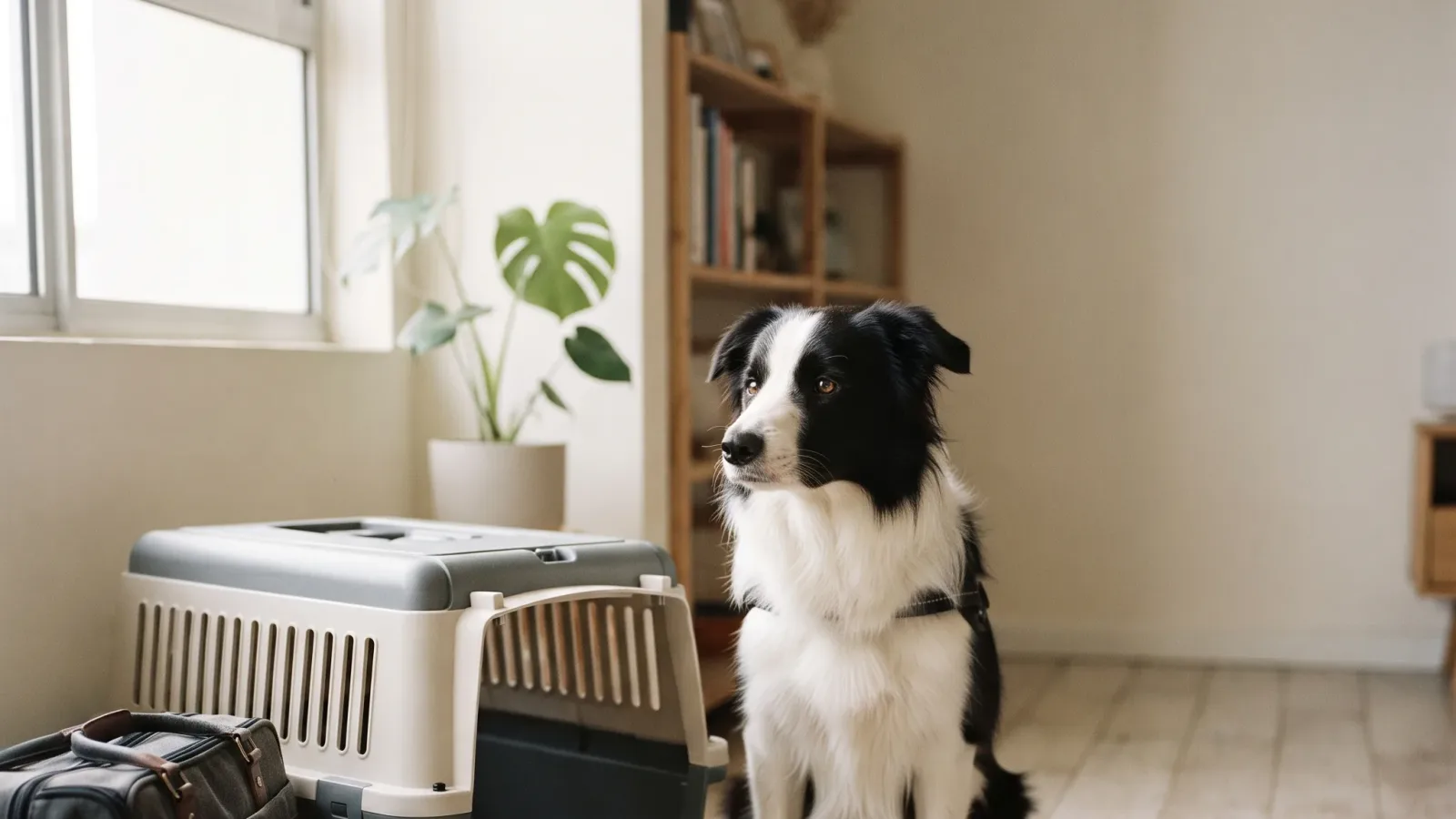
The travel crate is not a last-minute purchase. A dog meeting its crate for the first time at the airport is a dog having the worst possible introduction to it.
Buy it early, leave it open in the living room, feed meals inside it, and let the dog choose to sleep there. Two or three weeks of that turns a plastic box into a familiar den, and the difference on flight day is not subtle.
Check the airline's crate specification before buying rather than after. Requirements cover dimensions relative to the dog, ventilation, door fastenings and attached water bowls, and an undersized crate is refused at check-in with no appeal.
Already know your dates?
Skip the reading. Tell us the dates and what your dog needs, and we shortlist AVS-licensed boarders for you — free, no obligation.
Get matched with a boarderSection 07
Health paperwork, in plain English
Identity underpins everything. The microchip number is the thread that ties the dog to its vaccination history and to every certificate issued, so an unreadable or mismatched chip stops the process cold. Have it scanned early rather than assuming.
Vaccination records must line up with that chip number, with dates that satisfy the destination's conditions. The veterinary health certificate then sits on top, issued within a defined window before travel, which is why it is the last thing done and the easiest thing to invalidate by a delayed flight.
Carry paper copies in hand luggage. Not in the container, not only on a phone.
08 Moving a dog into Singapore instead
Coming the other way has its own gate. AVS states that a dog or cat being imported must be at least twelve weeks of age at the time of export, and the AVS requirements for importing dogs and cats set out the veterinary conditions that go with it.
Once here, licensing follows arrival, and HDB residents have breed and size rules to satisfy before the dog moves in. Our guides on the Singapore dog licence and HDB-approved dogs cover both.
Arriving families frequently need boarding on this side too, because a container arrives weeks after the family does.
A realistic timeline
| When | What happens |
|---|---|
| Three months out | Get the destination's written import conditions. Book the vet for any required testing. Buy the crate. |
| One month out | Confirm the flight and routing. Book interim boarding for the gap. Start crate acclimatisation properly. |
| Within 90 days of export | Apply for the AVS export licence. |
| Two weeks out | Final vet visit window opens for the health certificate. Confirm boarding dates against the actual flight. |
| Flight week | Dog moves to the boarder on handover day. Documents printed and in hand luggage. |
What a relocation agent does and does not do
A relocation agent is a logistics provider. They book the flight and the cargo space, supply or specify the crate, handle airport formalities, and often drive the dog to the terminal. For a complex route with a stopover, that is worth paying for.
What they do not do is replace you as the applicant for a personal pet export, and what they usually do not include is boarding. Compare quotations on scope rather than headline price, and ask explicitly whether the days between move-out and departure are covered.
What we are, in this process
We are not a relocation agent, and we do not sell or resell any part of the export process. We match owners with licensed Singapore boarders, which is the one leg of this that we know well and the one leg most relocation guides ignore. Our page on how we check every boarder sets out exactly what that check is, and getting your dog ready for a stay covers the fortnight before you hand them over.
Every rule quoted above links to the AVS page that states it. If a date, fee or condition matters to your move, confirm it on the government page on the day you act, because these change and this one does not update itself.
Keep reading
More straight answers on boarding, licensing and looking after a dog in Singapore. If you are ready to book, start from our main guide to dog boarding in Singapore or compare boarding prices.
 Health
 Kennel cough in Singapore: what boarders require
Symptoms, the bordetella shot, and why boarders ask for it two weeks ahead.
Read the guide Logistics
 Pet taxi Singapore: costs and how to get your dog to boarding
Published fares, what a pet taxi includes, and when Grab or a private-hire ride is allowed.
Read the guide Money
Money Pet insurance in Singapore: does it cover boarding?
What SG policies actually pay out for during a boarding stay, and the common exclusions.
Read the guideCommon questions
How do I export my dog from Singapore?
How long before the flight should I start?
Do I need an AVS export licence?
Where does my dog stay between move-out and the flight?
Does a relocation agent handle the paperwork for me?
How old must a dog be to fly into Singapore?
Is boarding during a move harder on the dog?
Ready to find your dog a safe stay?
Tell us the dates and what your dog needs. We match you with a vetted, licensed boarder — free.
Still deciding?
See how we check every boarder against the official AVS licensed register before we match you.
How we vet boarders Browse all boarding guides